


Key Takeaways:
Most health systems can identify purchased services margin improvement opportunity. The harder challenge is building systems to actually capture and sustain it.
Without clear governance and accountability structures, even well-negotiated contracts are prone to value erosion within months of implementation.
Purchased services span supply chain, finance, operations, IT, and clinical leadership. Initiatives that categorize it as a single department’s responsibility consistently underperform.
Common failure modes include diffused accountability, the absence of structured roadmaps, and no mechanism to hold vendors or internal stakeholders responsible to commitments over time.
Pathstone Partners helps healthcare organizations move from strategy to sustained results by building execution infrastructure that turns identified opportunity into realized savings.
The financial pressures facing health system leaders right now are unforgiving. Around 60% of health systems report that non-labor expenses have increased 6–10% over the last year, while reimbursement has failed to keep pace. Vizient projects that supply chain prices, including IT services, capital equipment, and outsourced services, will rise another 2.41% in 2026.
Purchased services represents one of the few categories large enough to actually move the needle, representing up to 25% of hospital operating expenses, which is one of the largest addressable cost pools for hospitals. Hospitals that actively optimize their purchased services contracts can see savings of 10–15% across indirect spend categories. For a health system that runs on $2B in operating expenses, that represents $50 – 100M in potential impact.
The pattern is familiar: a health system identifies millions in purchased services opportunity, builds a strong strategy, negotiates effectively, but captures only a fraction of what the project projected. This is not because the background work was wrong and not because the savings were not real, but rather as a result of a system that was not built to actually capture them – which is what we will discuss in detail in this article. This is the gap Pathstone Partners consistently encounters: the distance between identified opportunity and sustained value in purchased services initiatives.
Finding Opportunity is the Easy Part
With enough time and data, most organizations can surface meaningful margin improvement opportunity in purchased services, whether that be through vendor consolidation, utilization inefficiencies, or contract renegotiations. What tends to be more difficult is what comes after. An organization saying “we should standardize vendors across the system” is one thing, but aligning multiple facilities, clinical leaders, and operational teams to make that change, and hold the line when pushback comes – that is when healthcare organizations begin to feel the effects of these issues.
Driving utilization improvement is straightforward compared to driving behavior change across departments with competing priorities and real bandwidth constraints. This is where initiatives lose momentum. As the work shifts from analytical to operational, the complexity required to execute these initiatives ramps up quickly.
Pathstone worked with one health system committed to reduce contract labor reliance. With Pathstone Partners’ support, analytical expertise, and benchmarking, this health system achieved a 30% reduction in spend, and initially delivered on that commitment. However, without the governance to sustain the effects of a successful organizational change, the hours and spend gradually crept back toward pre-initiative levels. The strategy had worked, in theory – however the absence of a governance structure meant that the initiative fundamentally failed to achieve sustained impact.
Why Governance Matters More Than Most Teams Think
Governance is often treated like a liability. To most people it is interpreted as more meetings, more approvals, and more bureaucracy. But effective governance isn’t about adding unnecessary processes as much as it is about creating clarity where ambiguity would otherwise stall progress. When there is no governance, even basic questions are often the ones left unanswered:
- Who actually owns each initiative?
- What decisions need to be made, and by whom?
- How are trade-offs evaluated between cost, service level, and operational risk?
- How is progress tracked and communicated across stakeholders?
Without clear answers, even well-resourced initiatives stall. Work gets done in isolation, decisions can get deferred, and accountability diffuses until it belongs to no one. McKinsey research quantifies the impact – programs with clear roles and responsibilities are six times more likely to succeed than those without them.
Pathstone sees this dynamic surface consistently with IT renewals. Supply chain aligns with end users, establishes a clear baseline, secures commitment to reduce license counts, and negotiates an agreement reflecting that alignment, only to find a year later that the number of licenses have crept up again, and the organization is now absorbing overages. While the contract was negotiated correctly, an incorrect accountability structure meant value was lost in the long term. Pathstone estimates that 10-20% of benefit erodes in the first 2 years of an IS agreement due to lack of oversight of the contract and effectively managing the number of licenses allocated. While not all licenses additions are ‘bad’, and can in some cases signal organizational growth, if anticipated up front Pathstone can pre-negotiate tiered growth clauses in IS renewals to avoid unrealistic overage charges.
Execution is a Cross-Department Exercise – Misalignment Has a Cost
Purchased services sit at the intersection of supply chain, finance, operations, IT, and clinical teams, which creates execution risk when decisions span multiple areas and ownership becomes unclear. When accountability is diffused, it typically belongs to no one. Supply chain builds a strong case, but, without finance aligned on how savings will be tracked, the impact never shows up in the numbers. A vendor consolidation can get negotiated successfully, but without operational leaders being engaged early, the rollout can hit resistance.
What makes this work in practice is less about process than it is about relationships. Supply chain leaders who consistently drive results across departments do not just analyze opportunities, but rather they are “connectors”. They know which operational leader needs to be in the room before a vendor consolidation gets off the ground, which finance stakeholder needs to validate the savings methodology before anyone will act on it, and which clinical voices will determine whether a change actually sticks.
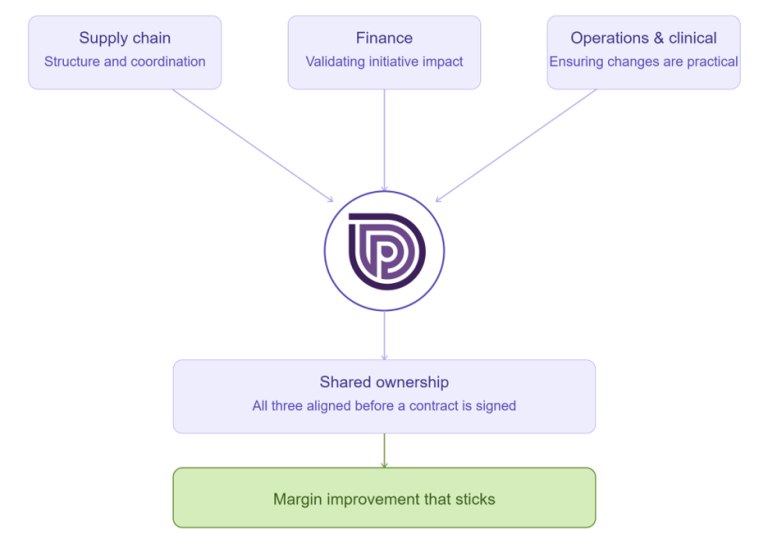
Pathstone’s approach is built around this reality. Rather than handing off a strategy for internal teams to execute, we embed ourselves as the central hub:
- Engaging the right people at the right levels
- Creating shared accountability across functions that don’t naturally coordinate
- Ensuring decisions get made rather than deferred
Cross-functional Alignment Is Only Half The Equation
The other half of the equation is knowing which initiatives to pursue first, and building the organizational trust that harder work requires. One of the most common pitfalls Pathstone often encounters is organizations creating long opportunity lists with no real path forward. The problem usually is not motivation for organizations, but rather the absence of structure and sequencing. Without a clear sense of priority initiatives, organizations either try to do everything at once or do nothing at all.
A more effective approach includes deliberate early wins – achievable, low risk, and visible initiatives – these do more than just save money: they build organizational confidence and stakeholder credibility that more complex initiatives, ones that require heavy lifting, actually need to get off the ground. We prove we can walk before we run.
This is how Pathstone Partners’ engagement with a large Pacific Northwest health system began. The client had a unique two-pronged goal to not only drive meaningful benefit, but was also in the process of rebuilding its sourcing team from the ground up. Given these factors, the client leadership team preferred to maintain control of project management functions and own the newly formed operational stakeholder relationships. This thoughtful, conservative approach to launching an engagement required the establishment of an entirely new internal sourcing governance structure and communication channels and subsequently required a trust-building period to align everyone with the overall goals and process.
By starting with targeted quick wins, Pathstone built the trust needed to pursue deeper, more transformative work alongside the organization’s leaders, which ultimately led in exceeding targets for margin improvement and equally as important, developed a focus on stewardship and collaboration between supply chain and operational leaders.
This kind of cross-functional integration, sequenced deliberately and built on trust, is rarely part of traditional consulting engagements, but is what differentiates Pathstone while ensuring organizations can sustain the benefits of an engagement. Organizations that execute well treat engagements as shared responsibility from the start – in practice meaning supply chain driving structure and coordination, finance validating impact, and operational and clinical leaders ensuring changes are practical before they are committed to.
Sustainable Improvement Requires Reinforcing The Right Behaviors Over Time
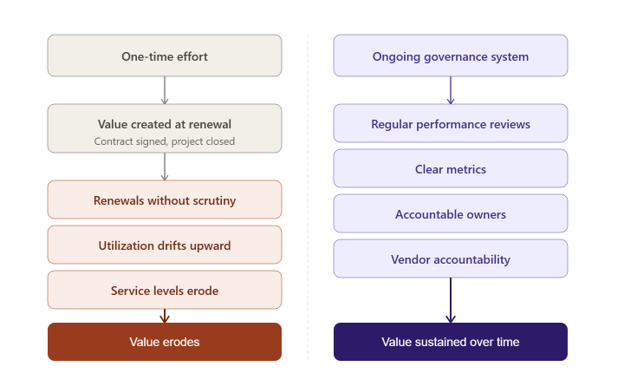
Capturing value is one challenge, however keeping it is another. Across client engagements, Pathstone has observed consistent patterns of erosion, including:
- Contract renewals without sufficient scrutiny
- Utilization levels drifting upwards
- Service levels eroding over time
Without ongoing governance, regular performance reviews, clear metrics, and accountable owners, value erodes just as quickly as it is created. Organizations that consistently outperform in purchased services aren’t revisiting these categories every few years at renewal. They are actively managing them, holding vendors accountable, and treating performance as an ongoing priority rather than a project with an end date in order to reinforce the right behaviors over time.
Where Pathstone Focuses
The organizations that consistently outperform in purchased services are not just better at finding opportunity, they are better at building the systems to capture and sustain it. That means putting as much thought into governance, accountability, and change management.
Pathstone Partners helps healthcare organizations across the full arc of purchased services improvement, from initial opportunity assessment through the governance and change management required to sustain results over time. The analyses our experts conduct, partnering with organizations creates opportunities, while our attention to execution is what delivers impact. This is why Pathstone has become a trusted advisor to organizations nationwide, with a reputation for long-term partnership and mentorship for organizational sustainability, often called to the table for repeat engagements.
Reach out to learn more about how Pathstone approaches purchased services from initial opportunity assessment all the way through to sustained results for your organization.