

Key Takeaways:
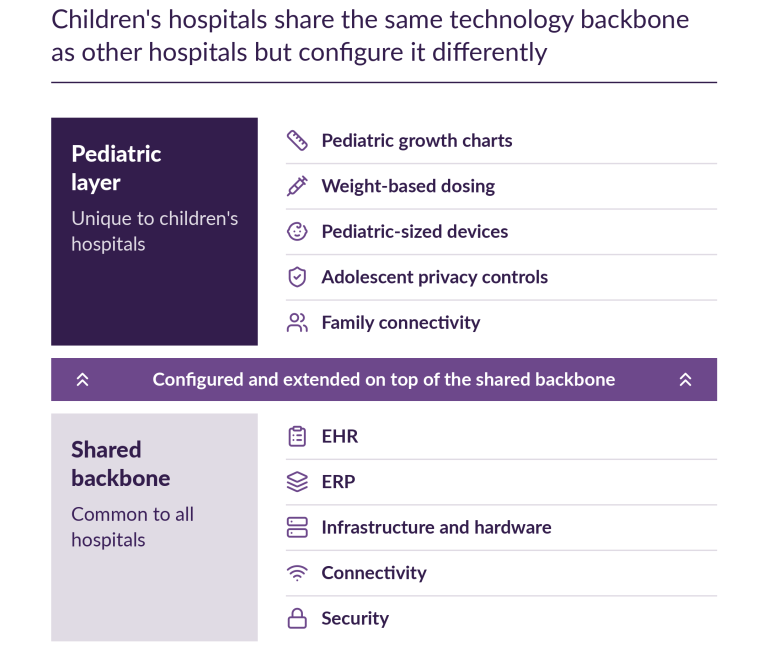
Children’s hospitals run on the same core EHR, ERP, and infrastructure as adult hospitals, but they need those systems configured and extended for pediatric care.
Most vendors build products and pricing around adult hospitals, so children’s hospitals often pay for capabilities they don’t need and then pay again to configure the ones they do.
Rapidly changing physiology and weight-based dosing require specialized devices and custom clinical software, which typically cost more to buy and maintain.
PHI access must adjust as a child moves through adolescence, which requires careful EHR configuration that adult health systems rarely face.
Lasting savings come from knowing which solutions can be shared across a system and which need a pediatric-specific approach, then sourcing accordingly.
Children’s hospitals are a small slice of the U.S. hospital market, yet they carry some of the most complex technology requirements in healthcare. Most vendors build their products and pricing strategies around adult hospitals, and, when a children’s hospital buys from the same playbook, it can send up paying again for capabilities it may not need and then pay again to configure the ones it actually requires. With climbing IT budgets and Medicaid covering roughly half of all pediatric patients, children’s hospitals have little room for incorrectly sourced products.
The scale of this gap is easy to see – of the total 6,100 US hospitals. American Hospital Association, the Children’s Hospital Association reports a membership of 200 dedicated children’s hospitals, including 100 functioning as dedicated acute-care centers, offering comprehensive clinical programs and acting as regional/national referral hubs.
U.S. hospitals spend an average of $10.5 million per year on information technology (IT), which represents approximately 2.5-5% of their total operating expenses. Hospital information technology costs are generally rising and expanding as a priority within overall budgets, with drivers of growth including investments in cybersecurity (cited by 55% of providers), electronic health record (EHR) modernization (46%), telehealth, and artificial intelligence/advanced analytics.
Where Pediatric Needs Are Similar to Adult Hospitals
For supply chain and IT leaders at children’s hospitals, the key question is where technology needs overlap with those of adult hospitals and where they truly differ. Many requirements are the same regardless of patient age or size, including foundational EHR and ERP systems, core infrastructure, basic connectivity, and security. Children’s hospitals diverge mainly in how these systems are configured and extended.
Where Pediatric Needs Differ
Most health system technology strategies include a hidden assumption: the patient is an adult- physically mature, within a predictable height and age range, and legally able to hold consent. None of these applies to children’s healthcare.
As a result, technology needs are different for children’s hospitals in several primary dimensions.
![]()
- Small Size and Rapidly Changing Physiology: Pediatric patients can range from a premature neonate to a late-teen young adult. Their physiology changes significantly over that time as they progress through developmental stages, requiring technology systems capable of adjusting operating logic and performance accordingly. Specialized medical equipment costs in children’s hospitals run 3% to 5% higher than in adult facilities.

![]()
- EHR Platform Considerations: Major EHR platforms offer pediatric-capable functionality, but pediatric care depends on parameters that differ from adult care, such as growth charts, age-specific guidance, neonatal flowsheets, and immunization schedules. Although much of this is available natively, children’s hospitals still invest in extra configuration and often add modules or third-party solutions.

![]()
- Medical Device Specialization and Integration: Connected care is common across health system types, but equipment for most adults does not service children. Pediatric units need smaller blood pressure cuffs, along with micro infusion pumps and ventilators that can deliver smaller volumes at slower rates.

![]()
- Highly Specific Dosage Requirements: Dosing precision matters far more in this population. Hardware and software must be designed and configured to deliver the correct dose and rate, avoiding adverse effects. Pediatric safety alerts, dosing calculations, growth charts, and communication workflows must be custom-programmed and maintained at a financial premium compared to adult platforms.

![]()
- Data Access Management/PHI and Decision Management Needs: The interactions of third-party relationships for pediatric patients creates additional legal and ethical complexity. Care decisions, consent workflows, and PHI access controls must all be integrated and precisely managed within technology systems to mitigate legal risk and clinical harm. Access also shifts as the patient grows. Systems must segment PHI access by role, age of the patient, category of the clinical record, and state laws and requires careful custom configuration.

![]()
- Connectivity Requirements for Pediatric Patients and Families: Pediatric patients often spend long stretches of time streaming / gaming while hospitalized. As family experience becomes a bigger priority for pediatric hospitals, bandwidth planning must account for the whole family.
Strategic Implications And The Pathstone Advantage
Pediatric and adult hospitals run on the same technology backbone but must be configured and managed differently for children. A growing patient’s changing physiology, need for treatment precision, and shifting privacy rights means technology decisions for pediatric care cannot be one-size-fits-all.
Cost discipline matters here – especially with today’s financial pressures. However, the lowest-cost option may not deliver the best value if it doesn’t align with how children’s care actually works. Lasting savings come from knowing which solutions can be shared across a system and those which require a more targeted approach, then sourcing and managing accordingly.
Pathstone Partners helps hospitals assess, plan, and source technology across applications, infrastructure, connectivity, and support services. Trusted by eight of the top ten children’s hospitals, we pair cost-management expertise with a deep understanding of pediatric supply chain needs, so our recommendations reflect both the budget and the patient’s bedside. The right technology strategy recognizes that children are smaller than adults, but not simply small adults – and the same guidance is true for their healthcare technology needs.
To engage with Pathstone Partners, request a No-Cost Opportunity Assessment today.