


Key Takeaways:
Contract labor rates and volumes have come down from pandemic peaks, but the category still represents tens of millions of dollars in annual spend at most health systems.
The larger and more durable savings usually come from controlling agency markups, which can range from 20% to 75% of base pay, and eliminating hidden pricing mechanisms.
Managing contract labor under a single structure gives hospitals the pricing discipline and data they lose when working with dozens of agencies independently.
Some health systems build an internal MSP while others partner with an external one, depending on scale, internal capabilities, and how much control they want to keep in-house.
Existing MSP programs often hold significant opportunity in renegotiable markup tiers and rate cards, program fees that have outgrown volumes, and data that isn’t being actively used to manage the program.
For most health systems, contingent labor now represents one of the largest and fastest-moving line items on the income statement, and the organizations that manage it well have a meaningful financial and operational advantage over those that don’t. Hospitals rely on contract labor in two primary scenarios: maintaining continuity of care during periods of low supply and/or elevated demand (e.g., vacation coverage, extended leaves, flu surges, hard-to-hire roles), or for targeted staffing needs when a specific expertise is needed for a defined scope and duration. Clinical contract labor includes nursing, allied health professionals, and physician locum tenens. Other contract labor includes non-clinical roles such as IT, finance, administration, and facilities.
The economics are straightforward when utilized volumes are modest – the challenge emerges at larger scale, where contract labor quietly becomes one of the most expensive decisions a health system makes – when pricing, governance, and utilization can be left unmanaged.
Shifts in the Contract Labor Market
The COVID pandemic distorted the contract labor market. According to the American Hospital Association, contract labor expenses increased nearly 258% between 2019 and 2022, with travel nurses accounting for a disproportionately large share. Average travel nurse bill rates peaked at approximately $133/hour in 2022. Since then, the market has normalized significantly. Bill rates have softened to roughly $107/hour, overall travel nursing volume has contracted 35–40% from its peak, and hospitals have grown more disciplined about contingent labor use.
However, normalization is not elimination. For most health systems, contract labor still represents tens of millions of dollars in annual spend, which makes it a critical area for strategic review and management.
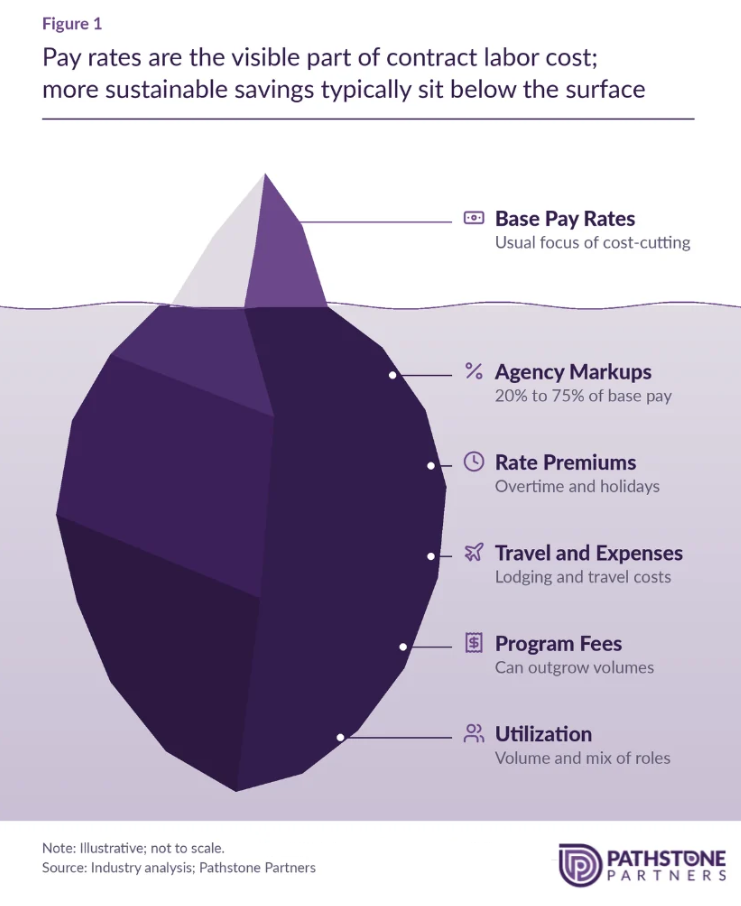
Most hospitals instinctively try to reduce contract labor costs by pushing down pay rates. While that is a real lever, it represents a fraction of potential cost saving strategies. More sustainable savings typically come from strategies such as controlling markups and eliminating hidden pricing mechanisms.
Contract labor costs are built from several components, including base pay, agency markups, travel and expense, rate premiums for overtime and holidays, and program fees. Industry analysis shows staffing markups can range from 20% to 75% of base pay depending on structure and urgency. This variance is where hospitals tend to lose money.
The Case For Centralization
Hospitals that work with dozens of agencies independently tend to have two problems – pricing discipline and a decrease in pricing visibility. A managed service provider (MSP) model can address both issues. MSPs can centralize contract labor operations under a single governance structure, standardize requisitions, manage supplier performance, enforce rate structures, and provide consolidated analytics through a vendor management system (VMS) that tracks requisitions, credentialing, timekeeping, and invoicing in one place. The combination of MSP governance and VMS transparency allows hospitals to shift away from reactive staffing to a more manageable and cost-effective solution in the longer term.
Some health systems build an internal MSP while others partner with an external MSP. The right model ultimately depends on scale, internal capabilities, and how much control an organization wants to keep in-house.
Having an MSP in place does not mean that all savings have been captured. In Pathstone’s experience, significant opportunity also sits in existing MSP programs, with markup tiers and rate cards that can be renegotiated, program fees that outgrow volumes, and need for continuous monitoring and management of centrally available data.
How Pathstone Partners Helps
Pathstone Partners works with health systems to transform contingent labor from a reactive expense into a controlled, value-driven need. Our engagements combine market intelligence, data analytics, operational expertise, and stakeholder alignment to deliver measurable savings without compromising access, quality, or workforce stability.
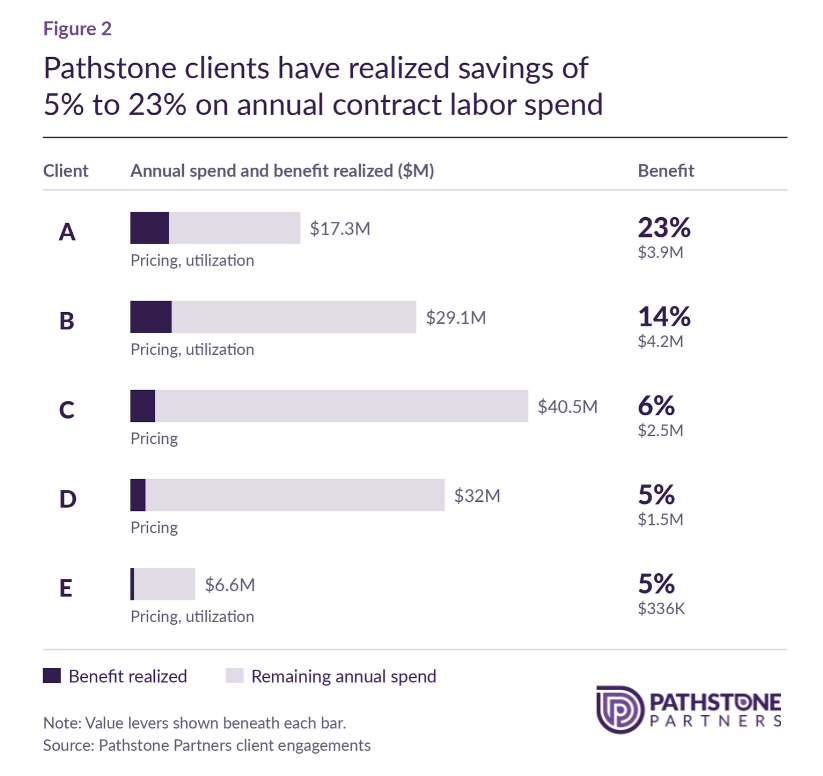
Below are examples where Pathstone Partners has successfully driven value with contract labor initiatives:
In practice, Pathstone helps organizations achieve these savings through the following processes and opportunities:
- Improving pricing transparency
- Developing RFP strategies that reflect current market dynamics
- Optimizing utilization by appropriately shifting volumes
- Surfacing incremental revenue opportunities that often go uncaptured
- Evaluating make-vs-buy decisions, including whether an insourced or outsourced MSP model is the right fit
Through our expertise and engagement, Pathstone is able to transform contract labor programs to operate with the same discipline as any other major cost category. The reality is that for most health systems, contract labor will continue to represent tens of millions of dollars in annual spend. The important gap will be between organizations that manage it effectively versus those that don’t.
Reach out to Pathstone Partners today to request a no-cost opportunity assessment and discover how we can help your organization plan for the future.