


Hidden Costs and Considerations Hospitals Face When Considering Purchasing AI-Capable Devices:
The healthcare AI market is expanding rapidly, reflecting a broader wave of AI-enabled clinical and diagnostic technology adoption across health systems.
Despite this momentum, healthcare AI adoption remains uneven, hampered by uncertainty around hidden costs, risks, and unclear ROI for purchasing decision makers.
AI investments deliver the strongest organizational returns when integrated directly into existing clinical/administrative workflows (e.g., imaging augmentation, administrative automation, predictive remote monitoring) rather than deployed as standalone “destination” tools.
Key cost considerations include emerging AI-driven subscription pricing models that can obscure total cost of ownership, and rising memory/infrastructure costs likely to be passed on to consumers.
Beyond cost, workforce readiness and PHI privacy/security reviews are critical non-cost factors that determine whether AI deployments succeed.
- Pathstone Partners helps hospital decision makers evaluate AI investment tradeoffs and navigate hidden costs and integration requirements specific to their organization.
Artificial Intelligence has long been part of IT Infrastructure and is evolving at a fast pace. With AI‑enabled PCs now offered by many manufacturers, the idea of “intelligence inside” has become more than a marketing phrase, it is a literal description of modern systems. For healthcare organizations, this shift matters more than most industries as the same AI capabilities being embedded into everyday computing are also reshaping the clinical, diagnostic, and administrative tools that directly touch patient care and provider workflows.
The emphasis has moved from isolated smart components to end-to-end devices designed to be intelligent, adaptive, and AI‑driven. At the same time, today’s hardware/software manufacturers and other IT vendors are offering – and often pushing – AI capabilities, promising powerful benefits to greatly boost efficiency, reduce provider/employee burnout, and improve patient outcomes. This dynamic extends well beyond general IT infrastructure into clinical and surgical hardware as well.
Pathstone Partners has observed shifts in the healthcare technology market, with greater emphasis on purchasing AI-backed devices. Organizations should consider the total cost of ownership and operations for AI-enabled technology, including data governance, training, and integration with existing workflows.
The market reflects this momentum. According to an April 2026 report from SNS Insider, the global medical robotics market has grown from approximately $23.5 billion in 2025 to a projected $102.75 billion by 2035, or a CAGR of 16.19%. More than 2.63 million robotic-assisted surgical procedures were performed in the U.S. in 2024, and surgical robotic systems held ~44% of the market in 2025. Such tremendous growth is driven by technological advancements, an aging population, and increasing demand for minimally invasive procedures.
Yet despite enthusiasm, this momentum has not translated uniformly into adoption in healthcare systems. There is tremendous wonder surrounding AI, but also fear, uncertainty, and doubt, resulting in low adoption. In an article outlining considerations for healthcare trustees, the American Hospital Association calls for trustees to develop an organizational partnership with AI, and to become aware of its “concepts and controversies”. AHA highlights the urgency of incorporating AI into an organization’s strategic planning process and specific health care applications, both for clinical and operational applications.
For purchasing decision makers, the challenge is practical; AI’s novelty is real, and the frontier is largely unmapped. Many leaders are not aware of all the hidden costs, risks, and pitfalls that come with AI-enabled purchases.
Based on our client experience, here is some general guidance on proposed AI use cases that do – and do not – currently justify the additional costs:
| Organizational Benefit Outweighs Costs | Organizational Benefit May be Limited |
|---|---|
| Augmenting imaging and diagnostic tools, particularly to enhance processing time and accuracy | Fully autonomous diagnostic tools, where outputs still require human validation |
| Automating administrative tasks, i.e., documentation or coding | Standalone predictive analysis not workflow integrated |
| Remote monitoring to perform predictive analysis | Organizations that lack data cohesion and governance |
| Integrating solutions into workflows so output is immediately actionable | General purpose AI tools that lack workflow-aligned specificity |
AI Use Case: Leveraging AI to Enhance Print Device Fleet
A large integrated academic health system in the northeast is leveraging AI-enablement to enhance their print device fleet. Using predictive analytics, their usage patterns can inform just-in-time supply replenishment to minimize human intervention and storage needs. Furthermore, data collection agents are used to analyze internal device components, predicting service needs before failures occur. The payoff extends well beyond cost savings, including fewer supply runs, less unplanned downtime, and IT/clinical staff freed up to focus on higher-value work.
AI Use Case: Leveraging AI to Improve Routine Logistics
Another example comes from a health system that uses autonomous robots to assist with routine logistics by transporting meals, medications, linens, and other supplies throughout its facilities. By automating repetitive delivery tasks, clinical and support staff spend less time moving supplies and more time focused on direct patient care. While these technologies require upfront investment and integration into existing workflows, they have the potential to improve operational efficiency, reduce staff fatigue, and enhance overall workflow efficiency.
Implementing AI-enabled radiology software has become standard practice across many health systems. New technology platforms exist which help clinicians prioritize urgent imaging findings and accelerate diagnosis. Rather than replacing the radiologist, the technology analyzes medical images in real time to identify potential findings and prioritize those studies for review. By helping clinicians focus first on the most urgent cases, organizations may reduce time to diagnosis and treatment while improving workflow efficiency.
A common feature of sub-optimal use cases is when the technology is deployed as a solution unto itself without appropriate consideration for how it integrates into each organization’s specific needs. What distinguishes these use cases above is that the technology was integrated into an existing workflow, rather than deployed as a standalone “destination”. When AI is not treated as a component of a broader system, but rather as a “destination” of sorts, ROI may become difficult to define, and harder to measure.
Cost Considerations for AI Deployment
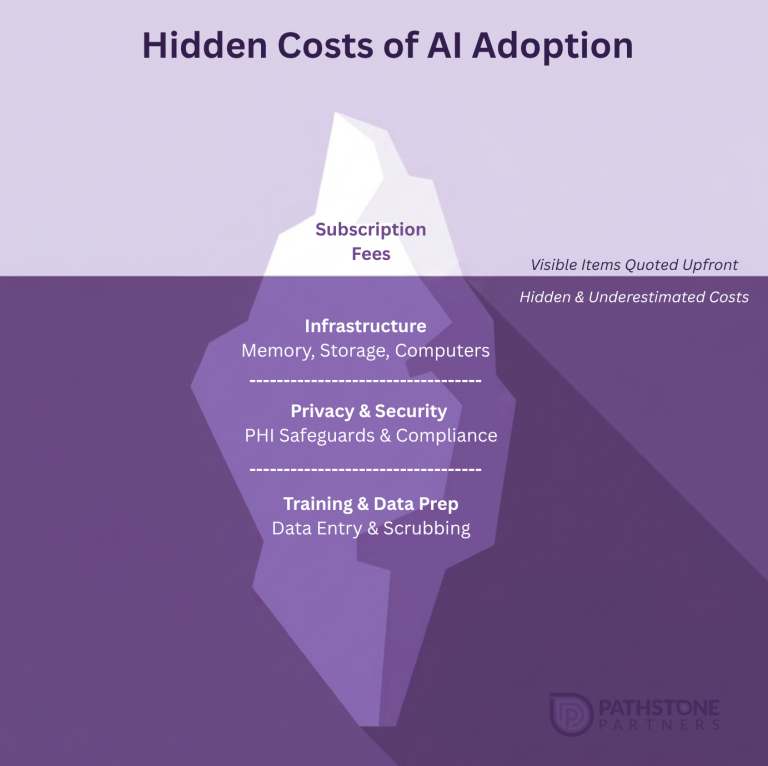
Several unique cost considerations may be at play with AI. New pricing models which incorporate AI are emerging, such as subscription packages that can obscure the total cost of ownership for an organization over time. Additional infrastructure costs, such as memory, must also be considered. Several memory companies’ stock prices have risen ~33% since Dec ‘25, reflecting rising demand from AI developers that will most likely be passed on to consumers through an upstream effect on pricing.
Beyond Cost: Operational and Privacy Factors
Non-cost considerations are just as important as ROI when deciding whether to deploy AI capabilities. Without proper workflow integration, even highly capable technology will likely produce a low return. Two factors deserve particular attention:
- Workforce readiness: Staff need training not just to use AI tools, but to prepare the data those tools depend on, such as entry, scrubbing, and formatting all affect output quality. Organizations should ask: how much data needs to be fed into the system to ensure reliable outputs, and what training is needed to prepare it correctly? Without defined processes, applications where AI is reducing cost or improving outcomes such as clinical decision-making or data analysis may not fully justify the investment.
- Privacy and security: Protected Health Information (PHI) requires safeguarding, and AI adds to both the risk and the complexity. Depending on where processing occurs (e.g., cloud, local storage, or a hybrid environment), the security exposure may change. A thorough security review should be a required step before any deployment, not an afterthought.
The Bottom Line for Organizations
AI is not a single, or simple decision. For organizations, AI is a series of decisions each with its own cost profile, integration requirements, and potential risk exposure. For hospital financial, technology and purchasing decision makers, the tradeoff between outlay and outcome must be weighed and evaluated, and as with most technologies, the successful leveraging of AI solutions requires maximum integration with organizational workflows and workforce.
Improved patient outcomes, provider and workforce efficiencies, and long-term cost savings are certainly on the horizon, but only when AI is deployed with intention.
Pathstone Partners works with hospital decision makers to navigate the new and exciting opportunities AI can afford, including understanding hidden costs and non-cost considerations as it relates to organization specific needs. To engage with Pathstone Partners, request a No-Cost Opportunity Assessment.