


Key Takeaways:
493 hospitals reported sustainability data through Practice Greenhealth’s 2025 Environmental Excellence Awards, generating $203 million in aggregate annual savings (up 15% year-over-year) while avoiding 185,000 metric tons of GHG emissions.
Hospitals with a formal climate resilience plan jumped from 38% in 2023 to 61% in 2024, even as U.S. hospitals continue to generate more than 5 million tons of waste annually.
The regulatory environment has split in two directions: facility-level waste and pharmaceutical compliance rules remain strict and actively enforced, while broader federal decarbonization incentives have been substantially rolled back since January 2025.
Sterile processing departments face a persistent technician shortage, with roughly 10,900 openings (average annual openings from growth plus replacement needs) needed annually, against a workforce of just 76,500.
Hospital margins remain thin, closing 2025 at roughly 1.3%, even as recent Medicaid and CHIP (Children’s Health Insurance Program) cuts are expected to raise uncompensated care costs and push more rural hospitals toward closure.
Pathstone Partners has helped health systems capture more than $4 million in combined annual benefit across waste, linen, shredding, and EVS initiatives, evidence that sustainability and margin protection are no longer competing priorities.
Hospital sustainability has spent three decades moving from a compliance obligation to a core operating priority. What began as a response to environmental and regulatory pressure has evolved into a discipline with real, measurable financial returns, one that hospital leaders increasingly can’t afford to treat as optional. For organizations navigating today’s thin margins, the question is no longer whether to invest in sustainability, but where the returns are largest and fastest to capture.
A Movement Three Decades in the Making
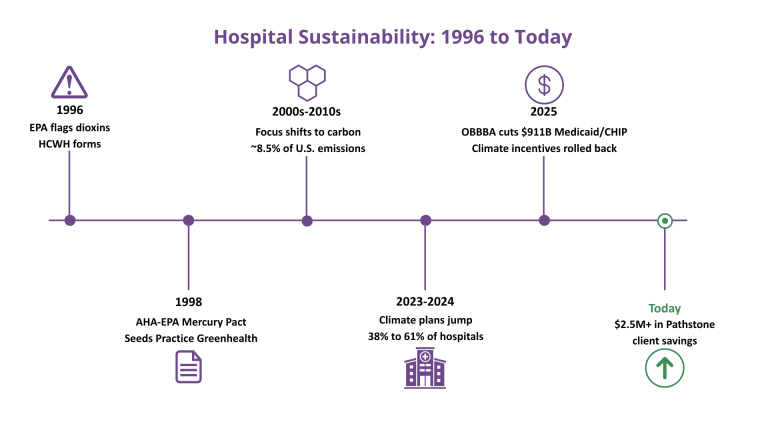
The organized push for hospital sustainability traces back to 1996, when the EPA identified medical waste incineration as the leading U.S. source of dioxins, among the most potent carcinogens known. Health Care Without Harm formed in direct response, a coalition of 28 organizations that helped cut the number of medical waste incinerators from roughly 4,500 in 1996 to fewer than 100 within a decade. A 1998 agreement between the American Hospital Association and the EPA committing hospitals to virtually eliminate mercury waste laid the foundation for Practice Greenhealth, now the sector’s leading sustainability network with more than 1,700 hospital partners. Through the 2000s and 2010s, the conversation broadened from toxic waste to carbon emissions, as hospitals came to account for roughly 8.5% of U.S. greenhouse gas emissions. The financial case has since caught up with the environmental one: research shows every dollar saved on energy carries the same margin impact as $20 in patient revenue, a ratio that is difficult for any CFO to ignore.
Momentum is Building Across Hospitals Today
Seven in ten healthcare facilities took concrete climate action in 2024, and the percentage of hospitals with a formal climate resilience plan jumped from 38% in 2023 to 61% in 2024. The examples span both non-pediatric and pediatric systems. Providence Health System saved $46 million in 2025 through waste reduction and renewable energy. Seattle Children’s reached carbon neutrality in 2025, cutting emissions 16% since 2022 while lifting its waste diversion rate to 47.4%, and Valley Children’s Healthcare built the largest pediatric renewable energy microgrid in the country, targeting a 50% emissions cut by 2030. Boston Children’s device reprocessing and single-use item repurposing program was significant enough to be published in the American Journal of Surgery in late 2024. Pathstone’s own pediatric client work reflects this same momentum, with active initiatives underway in medical waste management, solid waste handling, and device reprocessing.
Where Pressure is Concentrated
Waste remains the most visible pressure point. U.S. hospitals generate more than 5 million tons of waste each year, roughly 14,000 tons per day, of which 20-25% is plastic, and the global medical waste management market is projected to grow from $19.73 billion in 2024 to $23.88 billion by 2028. Regulatory activity is compounding the cost: 2025 amendments sharpened the legal line between hazardous chemical waste and regulated medical waste, while the EPA and DEA have both stepped up enforcement around disposal and controlled substance handling. In response, hospitals are rethinking waste at the point of care, and the “green operating room” concept, built around better segregation and tighter control of surgical overage, is gaining real traction. Device reprocessing has emerged as a particularly high-impact lever: Ohio State University Wexner Medical Center’s partnership with Stryker Sustainable Solutions generated $1.4 million in savings and diverted 60 tons of waste from landfills.
Sterile processing departments are under similar strain. A persistent technician shortage, with roughly 76,500 medical equipment preparers employed nationally in 2024, has left three in five hospital leaders naming SPD staffing a substantial barrier to efficiency. That gap is projected to widen. The Bureau of Labor Statistics (BLS) estimates roughly 10,900 openings will be needed each year through 2034, driven by both growth and worker retirements. That means hospitals will need to fill positions equal to more than 14% of the entire workforce every single year just to keep pace. Outsourcing has become one strategic response, and the number of hospitals adopting it is expected to triple in the coming years. New sterilization technology is helping too: vaporized hydrogen peroxide systems are gaining adoption because they can safely process heat-sensitive instruments. Underlying all of this is a patient safety imperative: the CDC estimates that 1 in 31 hospitalized patients acquires a healthcare-associated infection, which keeps pressure on sterile processing departments from easing even as staffing gaps widen.
Financial and Regulatory Headwinds
These operational pressures are compounded by a broader financial and regulatory squeeze:
- Median hospital operating margin closed 2025 at roughly 1.3% across more than 1,300 hospitals, with labor still comprising roughly 53% of nonprofit hospitals’ expenses, leaving little room for upfront sustainability capital.
- The One Big Beautiful Bill Act, signed into law on July 4, 2025, cut roughly $911 billion in federal Medicaid and CHIP spending over ten years, a change analysts expect will raise uncompensated care costs and push more than 300 rural hospitals toward closure.
- Federal decarbonization incentives have been substantially rolled back since January 2025, with the HHS Health Sector Climate Pledge removed from the HHS website, and a proposal to eliminate the agency’s Decarbonization and Resilience Initiative for hospitals entirely.
Facility-level compliance has moved in the opposite direction, growing stricter: the EPA’s Hazardous Waste Pharmaceuticals Rule continued rolling out at the state level through 2025, and DEA enforcement around controlled substance disposal has intensified.
The hospitals best positioned to navigate this environment are the ones treating sustainability as an operational priority rather thank a philanthropic one, since waste, energy, and efficiency programs are among the few remaining levers tat improve margin without cutting care.
How Pathstone Helps
Pathstone Partners has worked with health systems across the country to capture savings that are often hiding in existing vendor contracts rather than requiring new captial programs. Recent client examples include:
- Medical waste and EVS: Renegotiating the medical waste contract brought the per-pound rate down from $0.40 to $0.36, delivering roughly $246,000 in hard savings; a separate EVS RFP retained the incumbent cleaning vendor at improved pricing worth $418,000 annually.
- Shredding and linen/mop program: A shredding RFP delivered nearly $97,000 in cost avoidance, and a shift from a rental to hybrid disposable model for mops and microfibers delivered close to $1.0 million in combined pricing savings and rebates..
- Cleaning and janitorial services: An RFP across twelve vendors generated roughly $389,000 in hard savings while preserving scope..
Solid waste, pest control, and EVS: Similar initiatives brought the total combined benefit across all five engagements to more than $2.5 million annually.
While the pressures facing hospital sustainability programs are real, forward-thinking organizations can differentiate themselves by treating these initiatives as margin strategy rather than a side commitment. Those acting now, often by revisiting existing contracts rather than starting new programs, will be best positioned to protect both care quality and financial sustainability going forward.
Reach out to Pathstone Partners today to request a no-cost opportunity assessment to learn more about how we can work with your organization to drive cost savings through sustainability initiatives.

